“Los Confundidos” (The Confused): a documentary about coca at the UN
Written by
Giselly Mejía
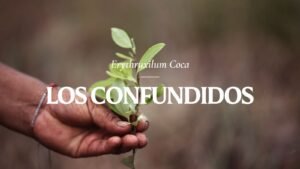
For over 60 years, decisions about the coca leaf have been made in rooms far from the Andes — without the people who have lived with the plant for generations.
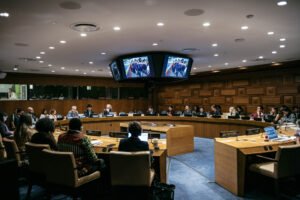
On March 12, 2026, in Vienna, during the 69th session of the UN Commission on Narcotic Drugs (CND), “Los Confundidos” (The Confused) premiered — a 19-minute documentary directed by Colombians Daniel Pineda and Nicolás Martínez that brings the voices of indigenous and peasant communities from Peru, Bolivia, and Colombia to one of the world’s most influential international policy stages on drug policy.
The response in the room was overwhelming. “It was a great success. People loved it, moved to tears. And we achieved our goal; what fills us most is that the message was sent and that the voices of all these people are now in these decision-making spaces,” said Nicolás Martínez, one of the directors.
Why this documentary exists now
In 1961, the UN Single Convention on Narcotic Drugs classified the coca leaf under Schedule I — the same category as heroin and cocaine, reserved for substances considered high-risk and without recognized medical use. To understand why that classification is so controversial, one figure helps: it takes approximately 300 to 600 kilograms of fresh coca leaves to produce a single kilogram of refined cocaine. Between the leaf and the powder lies a long and complex industrial chemical process. The plant and the alkaloid are not the same thing.
Since 1961, there have been several attempts to revise that classification, either to recognize the medicinal and traditional use of the leaf or to remove it from the international control system altogether. None succeeded. The most recent attempt was led by the Bolivian government roughly two years ago, later joined by Colombia. The CND opened a new review process that included an assessment by the World Health Organization’s Expert Committee on Drug Dependence (ECDD). In December 2025, the WHO published its decision: it recommended keeping the coca leaf in Schedule I, with no changes (see official statement).
A journey through six territories and three countries
Pineda and Martínez traveled through six regions across three countries — Los Yungas and Cochabamba in Bolivia, Quillabamba and the VRAEM in Peru, and the Sierra Nevada de Santa Marta and Cauca in Colombia — capturing landscapes of remarkable beauty and intimate conversations with people who have grown, used, and known coca their entire lives.
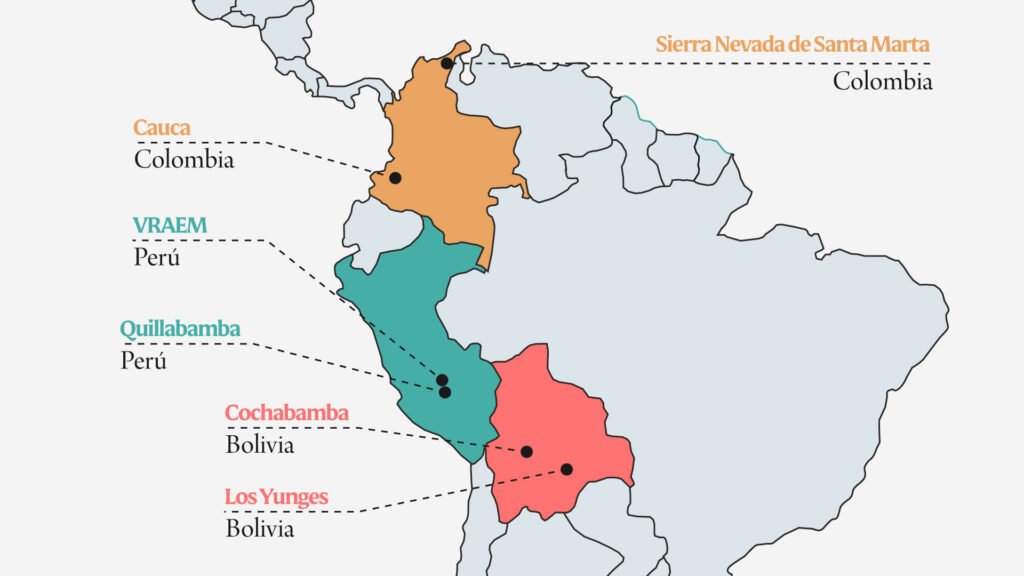
These are not neighboring communities; they are separated by thousands of kilometers, speak different languages, and have distinct histories. They are Andean peoples — inhabitants of the longest mountain range in the world, where coca grows wild and has been cultivated for at least 8,000 years. And yet, all of them share a deep and everyday relationship with the same plant. Coca is not the tradition of a small or isolated group: it is a cultural bond that spans an enormous geography and an extraordinary diversity.
Among the most moving moments in the documentary is the way these peasants and indigenous people speak about the plant. They call it “coquita” (little coca)— a diminutive, the affectionate way you speak of someone you love. They recount how they first encountered it as children, how their parents and grandparents taught them to use it, and how it is present in moments of work, rest, celebration, and healing.
The uses are concrete and everyday. For agricultural laborers, coca is a mild stimulant that helps them endure long hours of physical work at high altitude. For communities with limited access to healthcare, it is medicine: it relieves altitude sickness, stomach pain, and supplements calcium-deficient diets — the leaf is, in fact, high in calcium, iron, and vitamins.
Who are the confused ones?
The title of the documentary carries its own irony. The confused ones are not the Andean peasants and indigenous communities who have grown coca for thousands of years. They are the policymakers who, for over 60 years, have regulated a plant they barely understand. The documentary opens a window into a relationship with a plant through beautiful, everyday images of real people. And that, perhaps, is what makes it most effective.
“Yes, we know the UN is always controlling the coca leaf, and I truly say to other countries that are listening to me or will see me or are watching me: I wish they would not demonize it. We, as coca leaf producers, also don’t want it going to drug trafficking, or becoming a drug. I wish it could be consumed in its natural state, just as it is.”
— Cynthia Mollo, Huayrapata, Coripata (Bolivia)
“They have not consulted us on the issues of coca, have they? So that means that Western culture has this mindset of wiping out the plant by carrying out and practicing an ethnocide. This is an act of aggression. If in 25 years they have not managed to wipe it out and now they ratify the prohibition, they wont succedd. And they will be left in shame; it is a global shame today, above all for science.”
— Genaro Cahuana, peasant leader from Quillabamba (Peru)

MORE BLOGS
Mama Coca and the Futures We Have Yet to Imagine
What would happen if we thought about...
Painting as a Way of Mambear the World
This text was the first article I...